Thinking of applying for a funded PhD or how to write a strong PhD proposal for funded positions? That’s a bold and exciting step. But let me ask you this: What really sets one applicant apart from hundreds of others with similar grades and CVs? You might think it is your transcript. After all, a high GPA shows discipline. Or maybe you believe your recommendation letters will save you, especially if they come from well-known professors. Yes, these documents are very important and are the foundation, but not all that is needed.
These documents are your first real proof that you can think, question, and work like a researcher. It is the one piece of your application that is entirely yours. Your grades are shared by many. Your CV is a list of past achievements. But your proposal? That is a window into your future potential. As you already know, the stakes are high.
A weak PhD Proposal can quietly disqualify a very strong candidate. I have seen brilliant students with perfect grades get rejected simply because their proposal was vague, unstructured, or unrealistic. On the other hand, a strong proposal can open doors you didn’t even expect, sometimes even before your official interview.
So, how do you get it right? How do you write a proposal that doesn’t just get read, but gets remembered, funded, and handed to a top supervisor? Here is a step-by-step breakdown
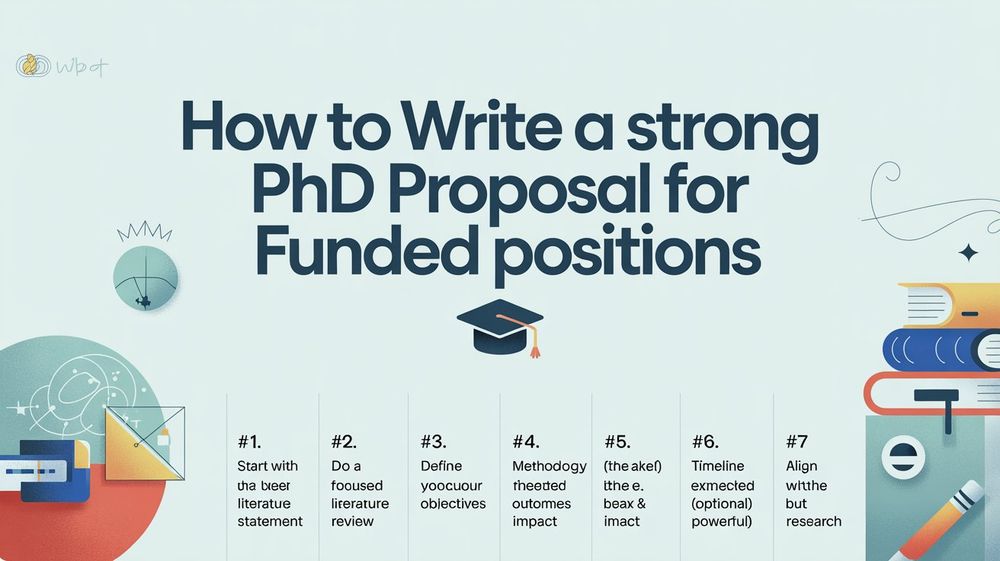
#1. Start with a Clear Problem Statement
Now, at the very beginning, what exactly are you trying to solve and more importantly, why should anyone care about your research topic? This is where many applicants lose their reader in the first paragraph. They start with vague, broad ideas like “studying climate change” or “improving education.” That is not a problem statement. That is a topic you might discuss over coffee. A PhD proposal demands precision.
The PhD supervisor is focusing on one locked door that no one has been able to open, something spectacular, something uncommon. Your proposal is your detailed plan to pick that lock. Avoid the vague language. Be specific. Be focused. Ask yourself these two powerful questions: What specific gap or challenge exists right now in your field? Why is it important to solve it, for whom and for what purpose?
Instead of writing: “I want to study how social media affects mental health,” you could write: “While existing research has established a correlation between social media use and anxiety among teenagers, there is a critical gap in understanding how algorithmic content filtering on short-video platforms specifically triggers acute stress responses within the first 30 minutes of use.”
The second version names the gap, the population, the mechanism, and even a measurable timeframe. That is clarity. Clarity here determines everything that follows. If your problem is fuzzy, your entire proposal will be fuzzy. Spend time on this section. Rewrite it five times if you have to. Get it right first.
#2. Do a Focused Literature Review
Now that you have a sharp problem, you need to prove that you are not wasting anyone’s time reinventing the wheel. That is the job of the literature review. This section has one mission: to demonstrate that you know what has already been done in your field. But do not just summarize papers. Anyone can write a list of abstracts. A literature review is not a book report. It is an argument; you need to do more than describe.
You must compare different studies. How does Smith’s 2019 model differ from Lee’s 2022 approach? Critique their methods and conclusions. Did they use a small sample size, or did they ignore a key variable? Then, finally, identify the gap clearly and explicitly.
Your goal is to build a bridge from existing knowledge to your own idea. You want the professor to nod and think, “Yes, we know all this.” Then you want to surprise them by pointing to the empty space on the map. You are essentially saying, “Here’s what we know… and here’s what’s still missing.” And then, “My research will fill that missing piece.”
Use a simple table or a mind map to organize your literature. Group papers by theme, not by author and always cite recent works (last 1-5years) unless you are citing a classic, foundational paper. A literature review that ignores the last three years of research looks lazy.
#3. Define Your Research Objectives
Another point many students ignore is the research objectives. If the objectives are vague, your entire proposal becomes weak. Look at your research objectives as the destination on a GPS. Without them, you are just driving around aimlessly. A strong set of objectives gives your potential supervisor confidence that you know exactly where you are going. Hence, a good objective must have the following:
- Clarity: No hidden meanings. A child could understand what you intend to do.
- Specific: Avoid words like “explore” or “understand” unless you define them. Use action verbs: identify, measure, compare, develop, test, and validate.
- Measurable: How will you know when you have achieved it? What evidence will you accept?
Aim for two to four strong objectives rather than ten scattered, weak ones. This will help your PhD to be focused and deep. Ask yourself, “What exactly will I have achieved by the end of this research? Will I have developed a new computational model? Will I have proven a causal relationship? Will I have created a prototype that reduces energy consumption by 15%? Write down those concrete achievements. That is your list of objectives.
#4. Methodology (The Deal Breaker)
This is where many promising proposals go to die. The methodology is the deal breaker. You can have the most brilliant idea in the world. You can write a beautiful literature review. But if you cannot explain how you will execute your research, it is just a dream. Supervisors and funding partners are practical people. They have seen too many ambitious proposals that collapse at the first real hurdle.
So, what are they asking? One simple question: Can this idea actually be executed? To answer that, you must clearly explain your plan. Do not be shy with the details. Do not hide behind vague phrases like “qualitative methods will be used” or “data will be analyzed.” Tell them exactly what you will do.
Your methodology section must cover:
- What methods will you use: Surveys? Experiments? Archival research? Computational modeling? Ethnography? Be specific.
- Why are those methods the right ones: Justify your choice. Why not a different method? Show that you understand the trade-offs.
- What tools or techniques will you apply: Software (Python, R, NVivo, SPSS)? Equipment (MRI, spectrometer, wind tunnel)? Statistical tests (t-test, regression, ANOVA)?
- Who or what will you study: Sample size? Population? Data sources? Case selection criteria?
- How will you ensure validity and reliability? Will you triangulate data? Use control groups? Address bias?
No fluff. No guesswork. No, “I will figure it out later.” Just solid, logical planning. Show them you have thought through the hard parts, the messy, real-world challenges of data collection and analysis.
#5. Expected Outcomes & Impact
So, your research works. You followed your methodology. Now what? What will it actually produce? This section is often rushed, but it is incredibly important, especially for funded positions. Funders want to see a return on their investment. They want to know that your PhD will lead to something useful, not just a thesis that sits on a library shelf.
Ask yourself: What will your project produce? Be concrete. Possible outcomes include:
New knowledge: A theory that challenges existing assumptions. A refined conceptual framework.
- A working model or prototype: Software, algorithm, device, or intervention.
- A practical solution: A policy recommendation, a clinical guideline, a teaching tool.
- Data sets or open resources: Curated databases, code libraries, or survey instruments that others can use.
Now, do not stop there, ask the more important question, “Who benefits from your work? Is it other academics in your narrow subfield? That is fine, but try to go further. Does it benefit a specific industry? A local community? A government agency? Non-profit organizations? Patients? Teachers? Farmers?
This is where you show value. You are answering the “so what?” question that every reviewer secretly asks, so do not just say, “This research will contribute to knowledge about renewable energy.” Say, “This research will produce a low-cost solar forecasting model that can be implemented by rural cooperatives in sub-Saharan Africa, potentially reducing energy costs by 20%.” That is impact. That is memorable and gets funded.
#6. Timeline (Optional, But Powerful)
Now, if you want to impress a supervisor instantly, add a clear, realistic timeline. It is optional, but trust me, it is powerful. Many applicants skip this section. They think, “I’ll figure out the schedule later.” That is a mistake. A timeline shows one thing immediately: You are not just dreaming—you are planning.
It demonstrates project management skills, which are one of the essential skills for completing a PhD on time and on budget. A PhD is a long marathon, not a sprint. Showing that you understand the phases of research tells the committee that you are mature and organized. You do not need to account for every single day. That would be unrealistic. Just break it down by year or by major semester. Be honest about time for setbacks (data collection always takes longer than you think).
Here is a realistic example for a 3-4 year PhD:
- Year 1 (Months 1-12): Literature review, ethics approval, coursework (if required), pilot studies, and methodology refinement. Also, building relationships with supervisors and potential field sites.
- Year 2 (Months 13-24): Main data collection or running experiments. This is often the messiest phase. Include buffer time for equipment failure or participant recruitment issues.
- Year 3 (Months 25-36): Data analysis, interpretation, and writing the first draft of your thesis chapters. Also, drafting at least one journal article.
- Year 4 (Months 37-48): Revisions based on supervisor feedback, finalizing chapters, preparing for defence, and submitting your thesis.
#7. Align with the Supervisor’s Research
This is the secret weapon that many applicants completely miss, and it is a costly mistake. Your proposal is not only about your interests. It is like a job application to work with a specific person or team. You are asking them to invest years of their time and their lab’s resources into you. Therefore, your proposal must connect with:
- The supervisor’s current research (read their recent papers!).
- The department’s overall focus (what are their strategic priorities?).
- The goals of the funded project (if you are applying to an advertised position).
Before you click submit, stop and ask yourself this one question: “If I were the supervisor, would I want to supervise this work?” If the answer is no, or even “maybe,” you need to revise. Do not be generic. Do not send the same proposal to ten different professors. That is a red flag. Instead, do your homework. Read two or three of their recent publications. Then, mention their work in your literature review. This shows them that you are not a random applicant and that you are a future colleague who already understands their world.
Conclusion
Let me leave you with one final piece of advice. It might surprise you. Stop trying to sound “too academic.” Many students think big grammar equals a strong proposal. They use complex words like “utilize” instead of “use,” or “elucidate” instead of “explain.” They think it makes them sound smart. It does not. It makes them sound insecure. What wins every single time is clarity, structure, and original thinking.
Your reader should never have to re-read a sentence to understand it; headings, bullet points, or logical flow make it easy to skim. Original thinking is a fresh angle, a clever connection, a genuine gap. Be direct. Be confident. Be clear.


